
Shirdi Sai Baba Under the Banyan Tree: 108 Lamps of Faith by the Sacred River
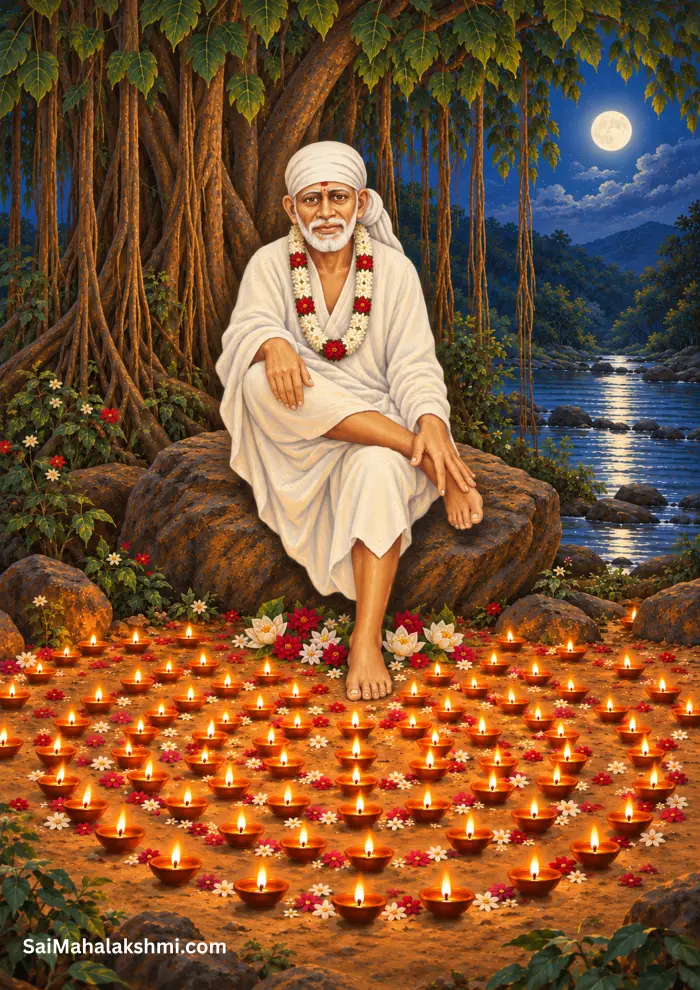
There are moments in devotion when silence seems more powerful than words. This painting of Shirdi Sai Baba imagines such a moment: Baba seated peacefully beneath an ancient banyan tree, dressed in a simple white kafni and white head cloth, while 108 earthen lamps glow before him beside a quiet river under the moonlit sky.
(If you like to buy this poster, message me on WhatsApp – +91 9787618752
I like to process manually until I know that I really wanted to sell posters
About the picture
The entire scene is built around stillness, simplicity and remembrance. Baba is not shown amid elaborate architecture or royal surroundings. Nature itself becomes the shrine. The banyan tree rises behind him with deep roots and hanging branches, the river moves gently through the night, and the distant landscape disappears into blue moonlight. In front of Baba, the warm flames of the lamps spread across the earth like a field of prayer.
The contrast between the cool night and the golden lamps gives the painting much of its devotional character. The moon illuminates the river from afar, while the small diyas illuminate the space immediately around Baba. One light belongs to the vast sky; the others have been lit by human hands. Together they suggest a beautiful relationship between divine grace and personal devotion.
The Simplicity of Sai Baba
Shirdi Sai Baba is remembered through an image of extraordinary simplicity. His clothing was plain, his surroundings were often modest, and yet devotees saw in him a presence that transcended outward appearance.
In this painting, Baba wears only white. The white kafni and head cloth help preserve that simplicity. There is no attempt to surround him with excessive ornamentation. His posture is relaxed and familiar, with one leg crossed and his gaze facing directly toward the devotee.
That direct gaze is important to the mood of the painting. Baba does not appear distant or inaccessible. He seems quietly present, as though a devotee has simply approached him beneath the tree and sat down before him.
A small natural flower garland offers the only decoration around Baba himself. It is intentionally restrained, allowing the whiteness of his clothing and the warmth of his expression to remain central.
Why 108 Lamps?
The number 108 has a long association with spiritual practice in Indian traditions. Prayer beads commonly contain 108 beads, sacred names are often recited in groups of 108, and many devotional practices use the number as a way of giving rhythm and completeness to worship.
Here, the 108 lamps can be imagined as 108 individual offerings.
Each earthen lamp is small. No single flame dominates the painting. But when so many lamps are placed together, their combined radiance transforms the entire riverbank.
This creates a simple devotional thought:
One prayer may appear small, but sincere prayers offered again and again can fill an entire life with light.
The lamps are intentionally earthen rather than elaborate metal lamps. Clay diyas belong to the earth beneath Baba’s feet. They make the worship feel personal and humble, as though ordinary devotees have gathered, placed each lamp carefully in the sand and offered its flame in remembrance.
Baba Beneath the Banyan Tree
The banyan tree gives the painting another layer of meaning.
Its enormous trunk, spreading branches and descending roots create the feeling of age, shelter and continuity. Baba sits naturally within this landscape rather than apart from it.
The tree almost forms a living canopy above him.
For a devotee looking at the painting, this can evoke the feeling of finding shelter: the world may continue beyond the tree, the river may continue flowing and the night may continue deepening, yet there is a peaceful place where one can sit in Baba’s presence.
The banyan tree also prevents the painting from feeling confined to a particular building or temple. The scene could belong to another age. It feels almost timeless.
The River That Continues to Flow
Behind Baba, the river moves quietly through the landscape.
A river is never completely still, even when viewed on a calm night. Water continues its journey. In the same way, human life continues through changes, uncertainties, successes, losses, relationships and responsibilities.
Baba remains seated while the river moves behind him.
That visual contrast can be contemplated in many ways. Life changes, but faith can provide an inner point of steadiness. Circumstances move onward, while remembrance gives the mind somewhere to return.
The moonlight reflected upon the water makes the river appear almost luminous. It connects the distant landscape with the foreground where the lamps burn.
108 Little Flames of Remembrance
The most beautiful part of this scene may be that every lamp can be imagined as carrying a different prayer.
One may represent gratitude.
Another may represent a family.
Another may be lit for someone suffering.
Another may carry a prayer for courage.
Another may simply say, Sai, stay with me.
Seen this way, the 108 lamps are not merely decorative elements in the painting. They represent 108 moments of remembrance.
A devotee does not necessarily need complicated words to pray. Lighting a lamp, repeating Sai’s name, sitting quietly for a few minutes or remembering Baba during an ordinary day can itself become a form of devotion.
When the World Becomes Quiet
The painting takes place at night because nighttime naturally changes the way we experience light.
During the day, a small lamp can easily disappear into the brightness around it. At night, even one flame becomes visible from far away.
Perhaps faith can sometimes be like that.
During comfortable periods in life, we may hardly notice the quiet strength given by prayer. During darker or uncertain periods, even a small act of remembrance can feel unusually bright.
The 108 lamps surrounding Baba therefore create more than physical illumination. They suggest hope appearing repeatedly in darkness.
Not one enormous flame.
A hundred and eight small ones.
Sitting Before Sai Baba
This painting can also be viewed almost as a visual meditation.
Imagine sitting quietly on the riverbank.
The banyan leaves move slightly in the night air. The river makes a gentle sound against the stones. The flames of the clay lamps flicker. Their golden reflections appear upon the surrounding earth.
And before you sits Sai Baba.
There is nothing you need to explain immediately.
Nothing you need to ask immediately.
For a few moments, you simply sit.
That may be one of the deepest ideas behind devotional art. A sacred painting does not only show us a figure. At its best, it creates a space into which the mind can enter.
A Prayer Inspired by the Painting
May every lamp we light remind us to bring a little more kindness into someone’s life.
May the flowing river remind us that difficult moments also pass.
May the banyan tree remind us to remain rooted when circumstances change.
May Baba’s simple white clothing remind us that peace does not depend upon outward grandeur.
And when our own path feels dark, may we remember that even a small flame is enough to begin illuminating the way.
Om Sai Ram.
Venkat